

The right cleaning frequency depends on more than the size of a business. Employee activity, customer traffic, the type of space, shared areas and daily operations all affect how quickly a workplace needs attention. A practical cleaning schedule should match those conditions rather than follow a one-size-fits-all routine.
There is no single cleaning frequency for every business
A quiet professional office and a busy customer-facing business can have completely different maintenance needs. Even two businesses of similar size may require different schedules because their spaces are used differently throughout the week.
The goal is to establish a routine that keeps the property consistently presentable without paying for a level of service the business does not actually need.
That usually means looking at traffic, usage, surfaces, shared areas and operating hours before deciding how frequently professional cleaners should visit.
What determines how often a business should be cleaned?
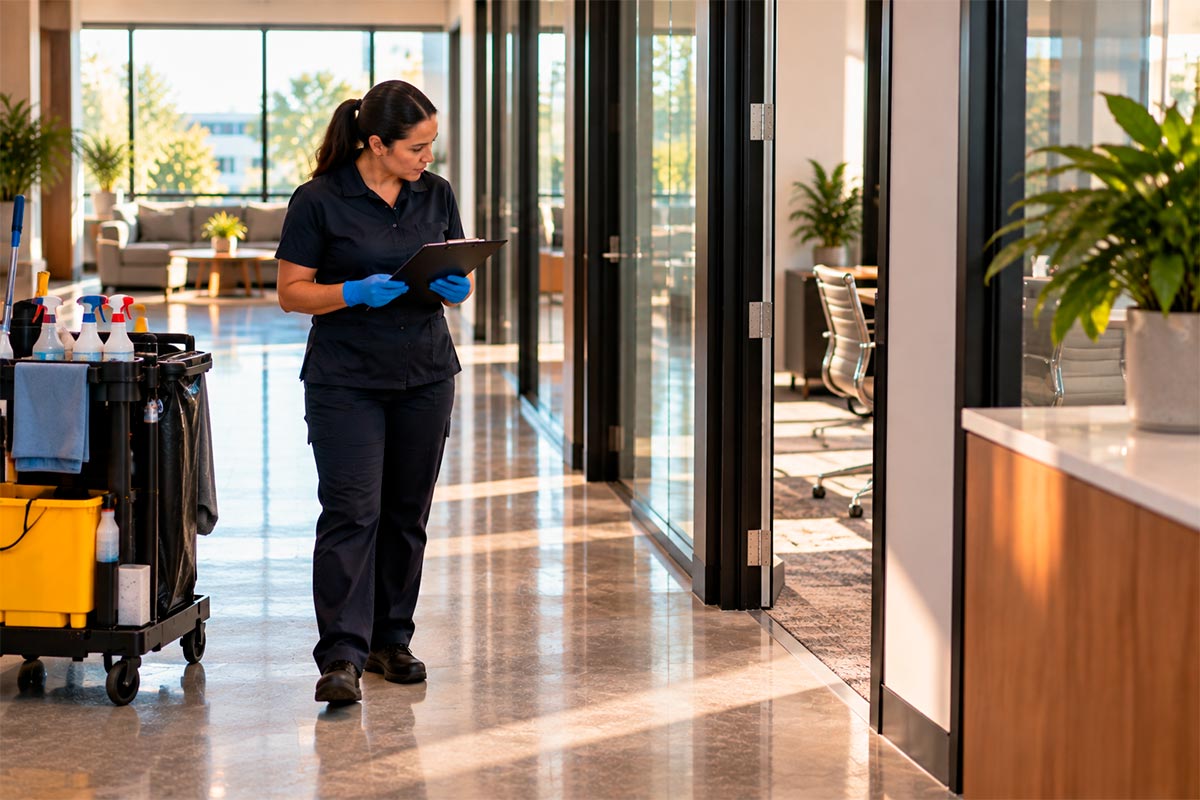
Several practical factors can help determine the right schedule.
Daily activity and foot traffic
Businesses with frequent employee movement, regular visitors or continuous customer traffic typically accumulate visible dirt and touch-related residue faster.
Entrances, waiting areas, counters, restrooms and shared spaces may require more frequent attention than areas that see very little activity.
A business does not necessarily need a full cleaning every day, but its busiest areas may benefit from more frequent maintenance.
The type of business
The work performed inside a property also influences its cleaning requirements.
An office with individual workstations may have different priorities from a retail shop, salon, studio or professional practice. Customer-facing businesses generally need their visible areas maintained consistently because the condition of the space forms part of the visitor experience.
This is one reason professional business cleaning should be planned around the actual operation rather than a generic checklist.
Shared spaces and high-use areas
Kitchens, break rooms, reception areas, restrooms and other shared spaces can quickly become the most demanding parts of a workplace.
These areas often need attention more frequently than private offices or low-traffic rooms.
A useful schedule separates the property into different maintenance priorities instead of treating every room as equally demanding.
Business hours and accessibility
Cleaning frequency is also affected by when the business operates.
Some companies may prefer service before opening, while others may need cleaning after employees and customers leave. Businesses with longer operating hours may require a different approach from those that close on a predictable schedule.
The best schedule should fit the operation without creating unnecessary disruption.
How to think about different cleaning frequencies
There is no universal rule that says every business should be cleaned a specific number of times per week. Instead, frequency should correspond to the property’s activity and maintenance needs.
How often should a business be professionally cleaned?
Cleaning frequency should reflect traffic, activity, shared spaces and the way your business operates. This framework can help you identify a practical starting point.
| Cleaning frequency | Often suitable for | Main consideration |
|---|---|---|
| Daily service | High-traffic or continuously active spaces | Maintains heavily used areas consistently |
| Several times per week | Moderate-to-high activity businesses | Balances regular upkeep with operational needs |
| Weekly service | Lower-traffic professional spaces | Works when daily buildup is limited |
| Customized schedule | Businesses with changing activity | Allows frequency to adapt to actual conditions |
This is a planning framework, not a fixed formula. Different areas of the same business may require different levels of attention.
The table is a planning framework, not a fixed formula. A business may use different frequencies for different areas, or increase service temporarily during busier periods.
When recurring commercial cleaning makes sense
A recurring service becomes particularly useful when a business wants to maintain a consistent baseline rather than wait until the property visibly needs attention.
Instead of treating every visit as a separate cleaning project, recurring service establishes an ongoing maintenance rhythm.
This can help businesses avoid the cycle of letting dirt and clutter build up and then requiring a more intensive intervention to restore the space.
For many companies, the value is not simply having the property cleaned. It is having one less operational detail to constantly manage.
What a recurring office cleaning schedule can include
For an office environment, the appropriate routine may involve regularly maintaining work areas, shared spaces, restrooms, kitchens, entrances and other frequently used sections of the property.
The exact scope can vary according to employee numbers, building layout and daily activity.
A smaller professional office may need a lighter schedule, while a busier workplace could require more frequent visits or additional attention to high-use areas.
The important distinction is between cleaning for appearance alone and establishing a maintenance routine that supports the way the office actually operates.
Signs your business may need more frequent cleaning

A schedule may need to be adjusted when the current frequency no longer matches daily activity.
Common indicators include visible buildup returning quickly after service, restrooms requiring attention before the next visit, increasingly untidy shared spaces or employees repeatedly noticing areas that are being missed.
Customer-facing businesses may also notice that reception areas, entrances or visible surfaces stop looking consistently maintained.
These signals do not automatically mean a business needs daily cleaning. They indicate that commercial cleaning frequency should be reviewed against current usage.
Signs your current schedule may be more than you need
The opposite can also happen.
A business may have a cleaning plan designed for a higher level of activity than it currently experiences. If spaces remain consistently clean, traffic is relatively low and there is little buildup between visits, the business may be able to reconsider its schedule.
This is why frequency should be reviewed as the business changes.
Staffing, operating hours, customer volume, office occupancy and even changes in how spaces are used can all affect the practical cleaning requirement.
How to build a commercial cleaning schedule

A useful commercial cleaning schedule starts with the property rather than a predetermined package.
Begin by identifying the busiest areas and the spaces that require regular maintenance. Then consider how quickly those areas typically become visibly dirty or heavily used.
Next, consider which tasks need to happen during every visit and which can be addressed less frequently.
This creates a more flexible service structure where routine cleaning handles ongoing maintenance while deeper work can be added when the property requires it.
Recurring service does not replace deeper cleaning
Routine visits and deep cleaning serve different purposes.
Recurring maintenance helps keep a business consistently cared for, while deeper cleaning can address areas that require more intensive attention.
For example, a business may maintain frequently used spaces on a regular schedule while periodically adding more detailed cleaning based on seasonal needs, changes in activity or accumulated buildup.
This combination can be more practical than expecting every recurring visit to accomplish every possible cleaning task.
Choosing a frequency without overpaying
The objective should not be to purchase the maximum number of visits.
Instead, businesses should look for a schedule that reflects their actual environment.
A useful conversation with a cleaning company should cover the type of business, approximate activity level, operating hours, priorities, shared spaces and expectations for recurring maintenance.
That information creates a stronger basis for deciding whether weekly, several-times-per-week or another arrangement makes sense.
A professional provider should be able to discuss those variables rather than simply assign the same frequency to every business.
Commercial cleaning in Monmouth County, NJ
For businesses across Monmouth County, local cleaning needs can vary considerably between professional offices, retail environments, salons, studios and other customer-facing properties.
GiveMe5 Corp’s commercial cleaning services are designed around the specific business environment, with recurring service structured around the property’s priorities and schedule.
The focus is consistent maintenance: keeping frequently used areas presentable, supporting a professional environment and reducing the amount of cleaning coordination business owners and managers have to handle themselves.
A cleaning schedule should adapt as your business changes
The right frequency today may not be the right frequency six months from now.
A business can become busier, change its hours, add staff, move to a larger location or simply use its space differently. Any of these changes can affect how often professional cleaning is useful.
That is why recurring service should be treated as an adaptable maintenance plan rather than a permanent number of visits.
The best schedule is the one that continues to reflect the property’s real needs.
When it is time to build a recurring cleaning plan
A business does not need to wait until its workplace looks neglected before creating a maintenance routine.
When cleaning becomes a recurring operational requirement, a structured service plan can make it easier to maintain standards consistently.
GiveMe5 Corp provides commercial cleaning in Monmouth County for offices, professional businesses, retail spaces, salons, studios, showrooms and similar local businesses.
For businesses evaluating their current needs, the next step is to look at the actual space, activity and schedule and build the service around those conditions.
Build a cleaning plan around your business
Explore GiveMe5 Corp’s commercial cleaning services, learn more about the company, or discuss your business’s specific cleaning needs.
Commercial cleaning services
Explore recurring commercial cleaning for offices, professional businesses, retail spaces, salons, studios and showrooms in Monmouth County.
About GiveMe5 Corp
Learn more about the company and the cleaning approach behind its residential and commercial services.
Request a cleaning quote
Share your business type, schedule and cleaning priorities to discuss a service approach that fits your operation.
FAQs
How often should a business be professionally cleaned?
The appropriate schedule depends on traffic, business type, operating hours, shared spaces and how quickly the property becomes visibly used. Some businesses may need service daily, while lower-traffic environments may work well with weekly or customized visits.
Is recurring commercial cleaning necessary for a small business?
Not every small business needs the same frequency. A smaller office with limited traffic may require fewer visits than a compact retail or customer-facing location with much heavier daily activity.
Can a commercial cleaning schedule change over time?
Yes. Changes in staff, operating hours, customer volume, occupancy or the way spaces are used can change cleaning requirements. A recurring plan can be adjusted when those conditions change.
Should routine cleaning and deep cleaning be scheduled separately?
They can serve different purposes. Recurring visits maintain the property on an ongoing basis, while deeper cleaning addresses areas that need more intensive attention. Many businesses benefit from combining both according to actual needs.
Build a cleaning schedule around your business
GiveMe5 Corp can help you determine a practical recurring cleaning approach based on your space, activity level and operational schedule in Monmouth County.
Get a quote